

Explore Ocular Drug Delivery With Us
NorthernBio offers comprehensive expertise and cutting-edge technologies to advance the development and evaluation of therapies for ocular diseases, ensuring precise assessments and robust data in the preclinical stage of ophthalmology.
Innovative Eye Disease Research
Consult a Scientist
We are a team of scientists who value open communication and collaboration. We work closely with our sponsors to provide customized solutions and expert support.
Targeted Delivery
Instrumentation & Capabilities
Equipment
Kowa SL-17 slit lamp
Heine Omega 500 indirect ophthalmoscope
Reichert Tonovet/Tonolab
RetCam III widefield color fundus camera
Top-Con TRC50-DX color fundus camera
Heidelberg Engineering Spectralis 6-mode OCT/cSLO
Bausch & Lomb Stellaris Elite anterior/posterior surgical
Zeiss OPMI CS/S4 operating microscope
Roland Consult Electroretinography Unit
Routes of administration
Intracorneal
Intravitreal
Periocular
Intracameral
Suprachoroidal
Subretinal
Species
Rabbit
Canine
NHP
Swine
Frequently Asked Questions (FAQs) about Ophthalmology
What routes of administration does NorthernBio specialize in for ophthalmic delivery?
Ocular routes of administration offer a unique challenge in ensuring that the therapeutic reaches the targeted regions of the eye. NorthernBio supports intracorneal, intracameral, intravitreal, periocular, suprachoroidal, and subretinal administration, allowing the route to be matched to the intended ocular compartment and therapeutic objective.
How are subretinal injections performed in large animal models?
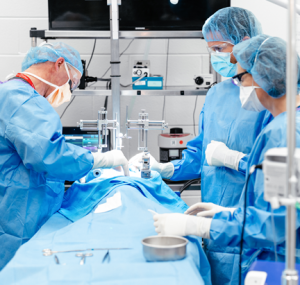
NorthernBio performs subretinal injections under a Zeiss operating microscope using the same posterior segment systems a retinal surgeon works with clinically, including the Bausch and Lomb Stellaris Elite.
What imaging and functional endpoints are used in preclinical ocular studies?
NorthernBio collects OCT and cSLO on a Heidelberg Spectralis for cross-sectional retinal structure, widefield color fundus images on RetCam III and Topcon TRC50-DX, intraocular pressure by Tonovet and Tonolab, slit lamp and indirect ophthalmoscopy scoring for anterior and posterior segment findings, and full-field electroretinography to measure retinal function. All of these can be repeated in the same animal over time, which is how ocular safety and efficacy studies track change.
Which species are best for ocular gene therapy studies?
Rabbits are common for tolerability and intravitreal work, swine and dogs suit subretinal surgery and retinal disease models, and nonhuman primates are used when the study requires a macula. NorthernBio supports ocular studies across all four species and can help sponsors select an appropriate species based on target, route, modality, endpoints and development objectives.
Suprachoroidal vs intravitreal injection: which route is better?
Neither route is inherently better; they access different ocular compartments and have different distribution profiles. Intravitreal injection is technically simpler and distributes broadly through the vitreous and retina. Suprachoroidal delivery targets the choroid and outer retina while keeping more of the dose away from the anterior segment. NorthernBio performs both, and sponsors often compare the two routes in one study to see which produces better exposure at the target tissue.
Where are NorthernBio’s ophthalmology studies conducted?
NorthernBio conducts ocular research at our Muskegon, Michigan facilities. Both are in West Michigan, an easy drive from Grand Rapids for sponsors who want to attend dosing or surgery days.
Partner With Us
Let’s work together to develop
life-changing treatments.
Join us in the pursuit of better lives through scientific innovation. Explore how NorthernBio can help you achieve your research goals.